 Download slides
Cross-border freight adapts to changing trade
Published: Thursday, August 06, 2026 | 09:00 AM CDT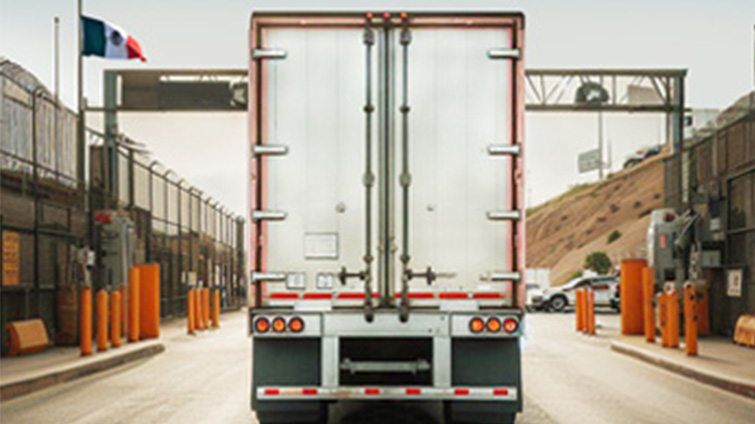
U.S.-Mexico
Visa enforcement and border controls limit cross-border capacity
Cross-border capacity continues to be influenced by supply constraints as much as by demand. One factor behind that is the difficulty of recruiting qualified drivers for both Mexico and U.S. carriers.
Strict B1 visa enforcement and English language requirements are decreasing the pool of Mexican drivers qualified or willing to do cross-border runs into the United States. This layers on top of tighter operational controls at the border.
More scrutiny of documentation and cargo value declaration, weight and cargo securement is making carriers more selective about the loads they will cover, particularly on northbound lanes with high demand. Because 81% of Mexico's land cargo moves by truck, these factors effectively limit overall freight capacity.
For shippers, the practical takeaway is that clean, accurate documentation, consistent freight patterns and desirable loading and unloading conditions are becoming as important to securing capacity as the rate itself. Carriers are willing to offer attractive rates and allocate capacity to shippers who make operations and compliance easy, rather than just going with the highest bidder.
Export growth accelerates into midyear
Mexican exports posted their fifth straight month of double-digit growth in June, up 34.4% year over year (y/y) to a record amount, with the first half closing at +24.6%, according to Instituto Nacional de Estadistica y Geografia (INEGI).
Every major export category expanded in both June and the first half except agricultural goods. Manufacturing exports rose 35.3% in June, led by electrical and electronic equipment (+19.7%) and food and beverage. Non-oil exports to the United States rose 35.8% in June, versus 25% to the rest of the world and the United States absorbed roughly 84% of Mexico's non-oil exports in the first half of the year, illustrating how concentrated growth is in the corridors carrying cross-border freight.
Imports of intermediate goods into Mexico grew 30.9% y/y in June, versus a more modest 8.8% gain in capital goods and now make up roughly 80% of total imports. These components and materials feed directly into assembly and manufacturing. Because intermediate goods are inputs for the production of future exports, this suggests the export surge so far this year isn’t a one-off spike and may extend into the rest of the year—a signal worth tracking for northbound freight planning into Q4.
Vehicle production stalls
Light-vehicle production in Mexico was roughly flat through the first half of 2026 (-0.4% y/y) and these exports grew just 1.4%, a sharp deceleration from prior years. Heavy-vehicle production and exports both fell double digits.
Recent OEM announcements, such as Toyota moving production of the Tacoma mid-size pickup truck from Baja to Texas once their Texas expansion is completed, show some shifts toward the United States, particularly for models exposed to tariff uncertainty. Yet Mexico remains a critical automotive manufacturing hub.
Freight demand reflects some of these patterns. Northbound lanes out of the Coahuila and Nuevo León corridors continue to present higher load-to-truck ratios compared to southbound, keeping carriers selective and holding rates firm. But because the underlying northbound-southbound imbalance of freight in these corridors is structural rather than tied to any single sector, capacity is expected to stay tight and pricing firm even as automotive volumes ease.
At the trade data level, total automotive exports have held up better than production figures suggest. Exports inclusive of vehicles, parts and components grew 7.6% in June and 1% for the first half of the year. Growth was slightly stronger for deliveries outside the United States (+11.3%) than into the United States (+7%), since Mexico has been diversifying into other markets.
Technology exports are becoming a second demand engine
Mexico remains the top U.S. trading partner, at almost 17% of U.S. imports versus 11.7% for Canada, but its lead over emerging Asian suppliers is narrowing. At the same time, computing equipment has overtaken automotive as Mexico's top export to the United States.
For freight, this reinforces demand in the same corridors already carrying automotive volume, in particular Bajío and Western Mexico around Jalisco. Where automotive demand is expected to soften, technology and general manufacturing freight is filling the gap, which should keep capacity tight and pricing firm in these corridors.
The broader capacity picture continues to reward planning. Drivers hesitant to go to the United States and the cost of repositioning empty equipment after northbound runs remain a limit on cross-border capacity. So shippers securing capacity early and holding consistent pickup and delivery schedules see meaningfully better pricing than those competing for spot capacity.
On trade policy, the 24 July shift from the U.S. Section 122 across-the-board tariffs to the Section 301 tariff regime keeps the effective tariff rate on Mexico goods the lowest among major U.S. suppliers, a positive for volume stability. For more details, see the Trade Policy and Customs section of this report.
Manzanillo port and road work collide
Mexico's busiest ocean container gateway is facing a tightening bottleneck. Expansion of the Colima-Manzanillo highway, combined with saturation at the Port of Manzanillo itself, has produced long queues and unpredictable transit times for drayage carriers serving the port. This is according to the Transporters Union of Manzanillo, which reports that carriageway congestion now affects arrivals on both the highway and at the port's access points.
The port's Centro Regulador Terrestre, a new dispatch and co-ordination facility, began operating 7 July to help manage truck entries more predictably, but construction on access roads is expected to continue weighing on cycle times in the near term.
The pressure comes as delivering volume keeps growing. Mexican ports moved 3.1% more containers in the first half of the year, with Manzanillo accounting for 43% of that national total. For shippers moving freight through Manzanillo, this points to continued variability in drayage appointment windows and inland pickup times through Q3. Consider building extra buffer time into inland transit or evaluating other ports such as Lázaro Cárdenas as secondary options.
Manifestación de Valour compliance deadline pushed back
Enforcement of the Manifestación de Valour Electrónica, the electronic filing that consolidates customs value documentation through Mexico's single window trade portal, will be delayed from 1 August to 30 September.
The extension gives shippers and customs brokers an additional two months to adapt processes before the requirement takes full effect. This pushes back the risk of border delays that had been flagged for August. Shippers are advised to treat 30 September as the operative date to have documentation processes ready.
U.S.-Canada
Gordie Howe Bridge opens a new chapter for cross-border freight
One of the most significant developments for North American freight transportation is the opening of the Gordie Howe International Bridge connecting Windsor, Ontario and Detroit, Michigan. The bridge provides a new commercial crossing option in one of the busiest cross-border freight corridors on the continent and is expected to improve long-term resiliency by reducing dependence on the Ambassador Bridge.
Estimates suggest commercial drivers could collectively save 850,000 hours a year through reduced congestion and more efficient border processing. For carriers, that translates into fewer delays, greater reliability and improved asset utilisation on cross-border freight. These benefits are particularly meaningful in an industry where driver retention remains a challenge and many drivers prioritise predictable schedules and timely returns home.
Beyond immediate transportation benefits, the bridge represents a strategic investment in the future of U.S.-Canada trade. Supply chains for automotive, industrial manufacturing and consumer goods rely heavily on efficient border crossings and the addition of new transit lanes helps reduce the risk associated with relying on a single major crossing.
While the bridge will not immediately lead to an increase in freight volumes, it should improve overall supply-chain efficiency across the region and support future growth.
Trade policy uncertainty continues to shape business decisions
While freight flows between Canada and the United States remain largely uninterrupted, uncertainty surrounding trade policy has become a growing concern for shippers. With the U.S.-Mexico-Canada Agreement (USMCA) now shifting to annual reviews instead of a six-year cycle, this has increased focus on the future of North American trade rules, particularly for industries with deeply integrated supply chains such as automotive, manufacturing and agriculture.
This uncertainty has been amplified by recent tariff actions affecting certain Canadian exports. In July, the U.S. administration announced 50% tariffs targeting goods including autos, dairy and alcoholic beverages. These are Section 338 tariffs based on allegations of discriminatory treatment toward American products and apply to goods whether or not they’re covered under USMCA.
Energy products, potash, critical minerals, fish and products subject to Section 232 tariffs are exempted. Effective 19 August 2026, the targeted scope and delayed implementation suggest they’re intended to bring Canada back to the USMCA negotiating table.
Canadian businesses are increasingly evaluating how potential policy changes could affect sourcing, production and investment decisions. Some Canadian manufacturers have reportedly delayed capital investments or are considering expanding production in the United States to reduce future trade exposure. For freight, the primary impact today is not reduced cross-border volume, but increased caution as businesses wait for greater clarity on the rules that will govern commerce moving forward.
Fuel costs and currency markets add pressure to pricing
Economic conditions are creating an increasingly complex pricing environment for carriers. Rising fuel costs have once again elevated operating expenses, forcing many carriers to pursue rate increases or become more selective about the freight they accept. This is occurring even as broader Canadian freight demand remains relatively soft, creating an environment where carriers are balancing cost recovery with competitiveness.
At the same time, the Canadian dollar has weakened to one of its lowest levels in several months. Under normal circumstances, a weaker Canadian dollar would support exports by making Canadian goods more competitive internationally and discouraging imports. However, current market conditions are far from typical. Trade policy uncertainty is tempering the traditional impact of currency swings.
Looking ahead, trade negotiations remain the key wildcard. Should USMCA discussions become more contentious or additional tariff measures emerge, freight markets could experience rapid shifts in sourcing patterns, manufacturing activity and transportation demand, creating elevated volatility heading into the fourth quarter.
 Actionable freight insights